News
Development Trends of Fully Automatic High-Speed Circular Saws for Metal Cutting: The Evolution of F
18 Mar February 2026 | LionNord
Development Trends of Fully Automatic High-Speed Circular Saws for Metal Cutting:
The Evolution of Full-Process Automation Integration
I. Overall Industry Development Trends: Driven by Both Scale Expansion and Technological Upgrading
The global market for fully automatic high-speed circular saws for metal cutting is entering a period of accelerated growth. In 2023, the global market size reached US$1.87 billion, and it is projected to increase to US$2.13 billion by 2025,
with a compound annual growth rate (CAGR) of 6.8%. The Chinese market is performing even better, with a market size of RMB 4.26 billion in 2023, and is expected to exceed RMB 5 billion by 2025. The CAGR is expected to remain
at 8.5% over the next five years, significantly higher than the global average. This growth is primarily driven by three core factors:
1. Explosive growth in downstream high-end manufacturing demand: The demand for high-precision cutting has surged in sectors such as new energy vehicles, aerospace, and wind power. For example, the processing of battery trays
for new energy vehicles requires a repeatability accuracy of ±0.02mm. Fully automated high-speed circular saws have become standard equipment on production lines, with related equipment procurement increasing by over 31% year-on-year in 2023;
2. Demand for labor costs and efficiency: The average annual increase in labor costs in the manufacturing sector is 8%-10%, highlighting the difficulty in recruiting workers. The investment return cycle for automation
equipment has shortened to 2-3 years, prompting companies to accelerate "machine replacement";
3. Policy and standards guidance: Policies such as the "Green Factory Evaluation Guidelines" incorporate energy efficiency and carbon footprint into assessments. The EU's CBAM mechanism is forcing green upgrades of
equipment and accelerating the elimination of high-energy-consuming traditional equipment.
II. Core Technology Development Trends: Deep Integration of Precision, Intelligence, and Green Manufacturing
1. Breakthroughs in Cutting Efficiency and Precision: New-generation equipment, through servo control and optimized design, significantly improves cutting speed.
For example, LAIANNUO Manufactured the HRS-420CNC intelligent CNC circular saw cuts a 42cm diameter seamless alloy steel pipe in just 48 seconds, increasing efficiency by 5-6 times compared to traditional band saws.
New breakthroughs have been achieved in precision control, with chamfer size tolerance within ±0.3mm, eccentricity within ±0.1mm, and surface roughness within Ra3.2.
2. Deep Empowerment by Intelligent Technology: The widespread application of AI visual inspection and IoT technology enables equipment to achieve adaptive adjustment of cutting parameters, real-time fault warnings,
and predictive maintenance, reducing unplanned downtime by more than 40%. Digital twin technology is used to simulate the cutting process, optimizing paths and parameters in advance, further improving processing consistency.
3. Green Manufacturing as a Key Indicator: Through technologies such as permanent magnet synchronous spindles and regenerative braking, single-piece energy consumption is reduced by more than 40% compared to traditional equipment.
AI… Driven margin compensation increases material utilization to 98.5%, while the closed-loop coolant system and automatic metal scrap recycling unit significantly reduce waste emissions.
III. Trend of Full-Process Automation Integration: From Single-Machine Intelligence to
Production Line Collaboration
The core development of fully automatic high-speed circular saws has shifted from single-device automation to multi-process, multi-device linkage full-process integration,
forming an integrated solution of "cutting - subsequent processing - handling - palletizing". Typical application scenarios include:
(I) Core Linkage Mode: Equipment Collaboration Creates a Value Closed Loop
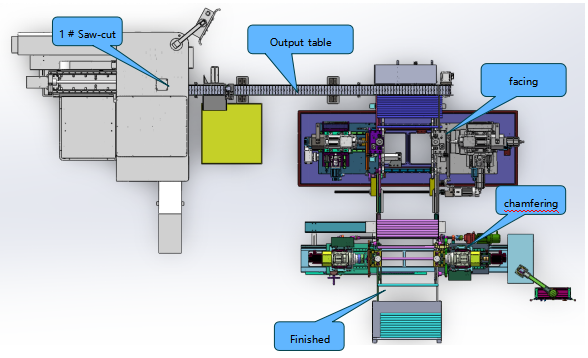
1. Fully Automatic Circular Saw + Chamfering Machine: Cutting - Chamfering Integration
◦ Implementation Path: The high-speed circular saw is connected to a dual-head servo chamfering machine via automated lines. Combined with automatic lifting and feeding, horizontal conveyor belts, and other logistics units,
continuous operations such as pipe/bar cutting, chamfering of inner and outer corners at both ends, and end face trimming are completed without manual intervention.
◦ Application Advantages: Suitable for automotive exhaust pipes, mechanical parts, and other scenarios. Changeover time is reduced by 60%, one person can operate multiple machines, and processing efficiency is improved by 3%.
More than double the size while ensuring dimensional consistency;
◦ Technical Highlights: Utilizes servo motor drive and touchscreen control, allowing for rapid adjustment of parameters such as chamfer size and processing length without the need to change clamping molds.
Adaptable to various workpieces including short materials, flat materials, and large-diameter pipes.
1. Cutting - Chamfering - Palletizing: Fully Unmanned Process
◦ Integrated Solution: Based on cutting and chamfering, industrial robots and palletizing systems are introduced to build a complete production line of
"circular saw cutting → chamfering machine processing → robot handling → weighing and detection → palletizing and warehousing". In some scenarios, processes such as medium-frequency furnace heating and sandblasting can be
added to achieve full automation of bar processing in forging plants;
◦ Core Value: Significantly reduces labor costs, reduces the impact of dust and noise on operators, and increases product qualification rate to over 99%. For example, Suzhou Qianxun Electromechanical's integrated solution has
been widely used in industries such as automotive parts and energy chemicals;
(II) Three Directions of Integrated Development
1. Modular Design Enhances Flexibility: The equipment adopts standardized interfaces, supporting rapid combination of units such as circular saws, chamfering machines, and palletizing robots. Processes can be flexibly
expanded according to production needs, adapting to multi-variety and small-batch production;
2. Digital Interconnection Enables Data Flow: Through MES The system connects production line equipment to the network, collecting real-time data on cutting accuracy, capacity, and energy consumption to create a
visual dashboard supporting production scheduling and process optimization, improving decision-making response speed by 50%.
3. Cross-domain technology integration: Combining laser cutting and 3D vision guidance technologies, it expands the processing capabilities for complex curved surface parts; in the aerospace field, it achieves integrated cutting,
chamfering, and inspection of difficult-to-cut materials such as titanium alloys and high-temperature alloys, with a single unit value exceeding 3 million yuan.
IV. Key Trends Outlook for the Next Five Years
1. Accelerated Domestic Substitution: The domestic production rate of core components such as CNC systems and servo motors has reached 41.5%, and the domestic production rate of complete machines is expected to exceed 90% by 2026.
Domestic companies will further expand their market share in the mid-range market and break into the high-end market.
2. Widespread Adoption of "Lights-Out Factories": 24-hour unmanned production lines are becoming the benchmark. Through the linkage of AGV logistics, automated three-dimensional warehouses, and cutting-chamfering-palletizing systems,
production efficiency will be increased by more than 40%.
3. Deepening Customization and Scenario-Based Applications: More specialized customized production line solutions will emerge for ultra-large diameter (Φ1200mm) workpieces in fields such as wind power and nuclear power,
as well as the rapid mold change requirements of the precision hardware industry.
4. ESG Compliance Becomes a Core Competitive Advantage: Functions such as carbon footprint traceability, energy consumption monitoring, and waste recycling will become standard equipment features. The level of greenness directly affects
market access and brand competitiveness. Exponential Increase in Production Efficiency: Breaking Through the Limitations of Manual and Standalone Operations
Automated circular saws, through "equipment linkage + intelligent scheduling," completely break through the efficiency bottlenecks of traditional production:
Continuous, Uninterrupted Operation: Eliminating the time lost from manual material changes and adjustments, enabling 24-hour uninterrupted production. Single-shift capacity is 2-3 times higher than manual operation. For example,
when cutting Φ50mm carbon steel bars, the automated production line can achieve a daily output of 800-1200 pieces, while manual operation only produces 300-500 pieces.
Accelerated Changeover and Process: Through touchscreen parameter settings and modular interface design, product changeover time is reduced from 30-60 minutes with traditional equipment to 5-10 minutes. Combined with the integrated
"cutting-beveling-palletizing" process, the overall production cycle is reduced by more than 60%.
Improved Equipment Utilization: The intelligent scheduling system can dynamically allocate tasks according to order priority, avoiding standalone machine idleness. Overall Equipment Effectiveness (OEE) increases from around 60% to over 85%,
reducing unplanned downtime. 40%.
Significantly Reduced Overall Costs: From "Labor Dependence" to "Lean Management"
Automation reduces lifecycle costs by decreasing manual labor and optimizing resource consumption:
Significantly Reduced Labor Costs: A fully automated production line requires only 1-2 maintenance personnel, replacing 6-8 traditional operators. Based on the average annual labor cost of 80,000-120,000 RMB in the manufacturing industry,
a single production line saves 480,000-960,000 RMB in labor costs annually, shortening the investment payback period to 2-3 years;
Material and Energy Savings: AI-driven margin compensation technology increases material utilization from the traditional 85%-90% to 98.5%. Taking the processing of Φ100mm alloy steel pipe as an example,
it can save over 300,000 RMB in raw material costs annually; permanent magnet synchronous spindles, regenerative braking, and other technologies reduce energy consumption per unit by 40%, saving 150,000-200,000 RMB in annual electricity costs.
tens of thousands of yuan;
Management cost optimization: Digital management reduces manual intervention in production scheduling and quality inspection, lowering the error rate and avoiding hidden costs such as material waste and equipment damage caused by manual operation,
resulting in an overall operating cost reduction of 25%-35%.
Breakthroughs in Processing Quality Stability and Precision: Meeting the Needs of High-End Manufacturing
Automation technology overcomes the quality pain points of traditional processing through "precise control + real-time monitoring":
More Precise Control: Servo motor drive and closed-loop control system achieve high-precision control of cutting length tolerance ±0.1mm, chamfer size tolerance ±0.3mm, and eccentricity ±0.1mm. Surface roughness is consistently within Ra3.2,
far superior to the ±0.5mm tolerance level of manual operation, fully meeting the precision requirements of high-end fields such as new energy vehicles and aerospace;
Extremely High Quality Consistency: Avoiding individual differences and fatigue errors inherent in manual operation, the product qualification rate is increased from the traditional 92%-95% to over 99%. For example, in the processing of automotive exhaust pipe parts,
the defect rate of automated production lines can be controlled below 0.5%;
Full-Process Quality Traceability: The MES system records the cutting parameters, equipment status, and inspection data of each product, achieving full lifecycle traceability from raw materials to finished products, facilitating rapid location and improvement of quality issues.
Safety and Compliance Upgrades: Creating a Green and Intelligent Production Environment
Automation not only improves production efficiency but also restructures a safe and environmentally friendly production ecosystem:
Risk-free Operational Safety: Fully enclosed processing design and automatic loading/unloading systems keep operators away from the cutting area, dust, and noise, completely eliminating safety accidents such as saw blade injuries and flying metal chips,
significantly improving the safety level of the working environment;
Environmental Compliance: Closed-loop coolant systems reduce wastewater discharge, automatic metal chip recycling units improve resource utilization, and AI-optimized cutting parameters reduce energy consumption and waste generation,
fully complying with policy requirements such as the "Green Factory Evaluation Guidelines" and the "EU CBAM Mechanism," avoiding the risk of environmental penalties;
Significantly Reduced Labor Intensity: Replacing repetitive manual handling, unloading, and stacking of high-intensity labor, especially suitable for processing large-diameter pipes and heavy workpieces, reducing reliance on physical labor
and improving employee work experience.
 English
 chinese